I have a new article out in Political Studies. The paper is by me and Rasmus Tue Pedersen from VIVE - The Danish Center for Social Science Research.
This one dives into a tricky but important question: how do citizens react when politicians try to explain unpopular public budget cuts? Budget cuts often spark strong reactions, but public budgets themselves are complex and hard to understand. So politicians have a range of communication strategies at their disposal when trying to justify cuts—and we wanted to know how citizens responded to some of the most used ones.
We tested three common strategies:
Numerical reframing—breaking big budget numbers into smaller, easier-to-digest pieces (like per capita costs).
Justifications—offering explanations that highlight tradeoffs or provide context to help citizens understand why cuts are necessary.
Excuses—shifting responsibility for the cuts onto other actors (a kind of blame-shifting).
Using a large survey experiment with over 3,000 participants, we looked at how each strategy affected citizens’ attitudes toward a municipal school budget cut.
Here’s what we found:
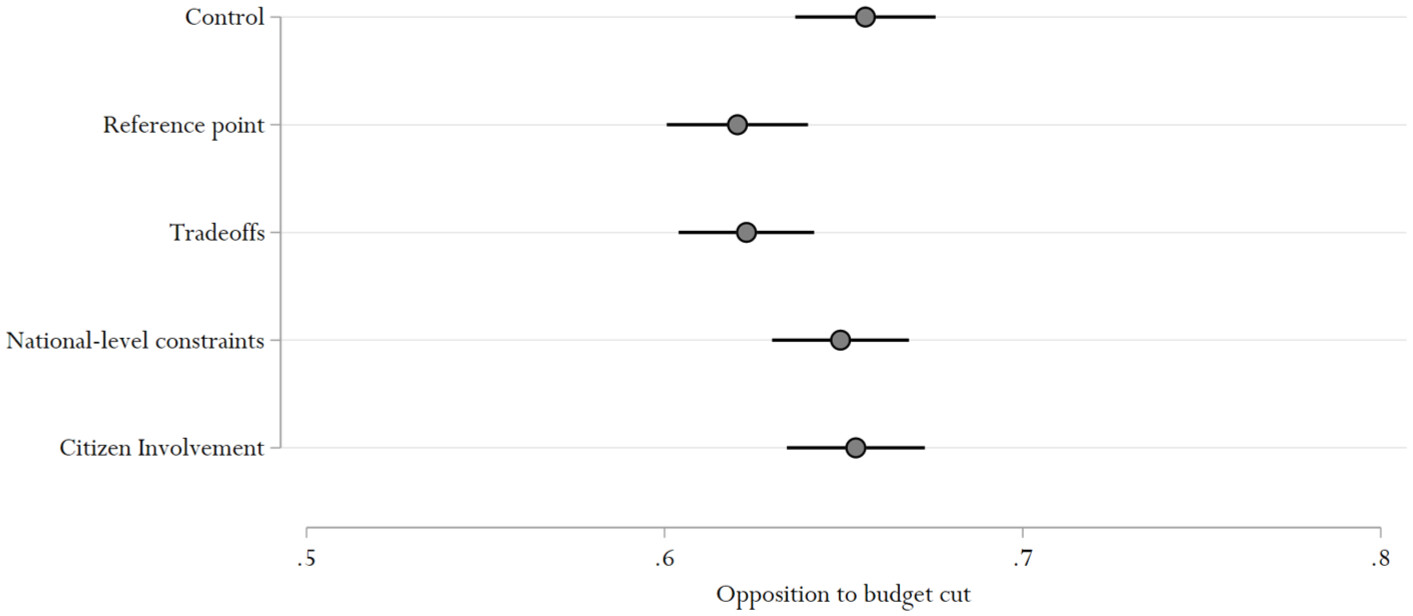
Numerical reframing didn’t move the needle much.
Excuses or blame-shifting also failed to reduce opposition.
Justifications, however—when politicians openly explained tradeoffs or gave citizens useful reference points—helped lower opposition somewhat.
That said, the effects were modest, and citizens’ background and attitudes still played a big role in how they reacted.
This research sheds light not only on political communication and persuasion but also on the challenges politicians face when discussing public budgets with citizens. For anyone interested in how budget debates play out in the public sphere, I think you’ll find the article worth a read.
And here’s a figure from the paper: